C if My Variables Are Declared in Header Do I Need to Do It Again in cpp File
C language has numerous libraries that include predefined functions to make programming easier. In C linguistic communication, header files contain the gear up of predefined standard library functions. Your request to use a header file in your program past including information technology with the C preprocessing directive "#include". All the header file have a '.h' an extension. By including a header file, we can utilise its contents in our programme.
C++ besides offers its users a variety of functions, one of which is included in header files. In C++, all the header files may or may non stop with the ".h" extension but in C, all the header files must necessarily terminate with the ".h" extension.
A header file contains:
- Part definitions
- Information blazon definitions
- Macros
It offers the higher up features by importing them into the plan with the help of a preprocessor directive "#include". These preprocessor directives are used for instructing compiler that these files demand to be processed before compilation.
In C program should necessarily contain the header file which stands for standard input and output used to take input with the help of scanf() and printf() function respectively.
In C++ program has the header file which stands for input and output stream used to have input with the help of "cin" and "cout" respectively.
There are of 2 types of header file:
- Pre-existing header files: Files which are already bachelor in C/C++ compiler nosotros only need to import them.
- User-defined header files: These files are defined past the user and can be imported using "#include".
Syntax:
#include <filename.h> or #include "filename.h"
We can include header files in our plan past using one of the above two syntax whether it is pre-divers or user-defined header file. The "#include" preprocessor is responsible for directing the compiler that the header file needs to exist processed before compilation and includes all the necessary data type and function definitions.
Note: We tin can't include the same header file twice in any programme.
Create your own Header File:
Instead of writing a big and complex code, we tin create your own header files and include them in our program to use it whenever we want. It enhances code functionality and readability. Below are the steps to create our own header file:
- Write your own C/C++ code and save that file with ".h" extension. Below is the illustration of header file:
CPP
int sumOfTwoNumbers( int a, int b)
{
render (a + b);
}
- Include your header file with "#include" in your C/C++ program every bit shown below:
CPP
#include "iostream"
#include "sum.h"
using namespace std;
int master()
{
int a = xiii, b = 22;
cout << "Sum is: "
<< sumOfTwoNumbers(a, b)
<< endl;
}
Below is the output of the above program:
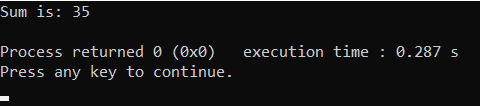
The output of the above program.
Including Multiple Header Files:
You lot tin use various header files in a program. When a header file is included twice within a programme, the compiler processes the contents of that header file twice. This leads to an error in the plan. To eliminate this mistake, conditional preprocessor directives are used.
Syntax:
#ifndef HEADER_FILE_NAME #define HEADER_FILE_NAME the entire header file
0 Response to "C if My Variables Are Declared in Header Do I Need to Do It Again in cpp File"
Post a Comment