Read Theough First Aid in 4 Days

Virtually everyone preparing for Step 1 volition use UWorld and First Assistance. But are yous using them correctly, or are you wasting your time? The stakes are high. The USMLE Step 1 is the virtually critical exam near of us volition take in our medical careers. Step 1 remains the most cited factor for giving residency interviews. Programs use it to screen applicants; they reject roughly 50% of all applications without reading them thoroughly.
So every med student wonders: how practice I utilise UWorld and First Aid to maximize my Step ane score? What does it take to get a 240+ or 250+?
Here, you volition learn:
- Why most students waste product time using Get-go Aid and UWorld
- The origin of First Help, and how you lot should apply it to your advantage
- How I studied from UWorld and Kaplan to heighten my score 34 points (from an initial NBME of 236 to my final score of 270)
- How to know whether you lot've mastered a topic
Table of Contents
Why Most Students Use Showtime Help + UWorld Incorrect
Most students will use resources like Get-go Aid and UWorld. The question is, "how?"
(To read Beyond UFAP: Why a List of Resources Isn't a Proficient Step 1 Strategy, click here).
Many prefer to read First Aid first. So, they apply UWorld to "examination themselves" on the material. In other words, they will learn the cardiology section in Beginning Assistance, then exercise cardiology questions from their QBank.
First Aid before UWorld seems logical; many students follow it. Notwithstanding, I don't like the "First Help-First" approach for two reasons:
First, without a Strong Foundation, Reading Get-go Assistance = Waste of Fourth dimension
Ever heard the communication, "just read Outset Assistance"? It's horrible advice. Why? Considering unless you know the material well commencement, First Aid won't teach you. (I'll explain why later).
If yous know antiarrhythmics well already, First Aid will assistance refresh your memory. However, if your fundamentals are weak, Outset Aid isn't the solution.
Their explanations have improved over the years. Even so, the essence of Get-go Aid is the same: condensed facts you need to know for the exam. Information technology is not conducive for having an integrated understanding of the material.
2nd, passive Reading Helps Us Recognize (Just Not Utilise) Knowledge
Take you lot always read/listened to something passively, and thought, "Wow, I sympathise this!" Then, in a QBank question, you lot failed to employ it to the vignette?
This disconnect between what we can recognize, and what nosotros can apply is enormous. I may come across a passage on Hashimoto'due south and call back, "Oh, I've seen that earlier!" But when I'one thousand forced to differentiate between Hashimoto's and subacute granulomatous thyroiditis I autumn flat.
Waiting to do QBank questions but delays the identification of our cognition gaps. Why? Learning new material from First Aid is challenging and then we oftentimes resort to memorizing the words on the page. (Again, learning from First Aid is painful). But because we memorized the information, nosotros get the question incorrect. Likewise tardily, we realize nosotros never really understood the textile.
The result of memorizing First Help? Having to repeat the unabridged procedure, learning the material nosotros never understood in the outset identify.
The most obvious instance of time-wasting? Students who read all of First Aid before they practice any QBank questions. They do their "first laissez passer," thinking they demand to run into everything earlier they practise practice problems. Simply later on their first practice test/QBank questions do they realize the error of their means.
(To read How Are USMLE Questions Written? ix Open Secrets for Impressive Boards Scores, click here).

Mastering the fundamentals from the beginning saves time and leads to a college score.
The "Showtime Aid-First" arroyo wastes fourth dimension and gives us less time to improve our scores. Instead, here are the iv keys to using UWorld and First Aid to maximize your Step 1 score.
one. Empathise Starting time Aid's Purpose/Origin
So many people follow the dogma of "just do First Assistance." However, few terminate and consider its purpose.
(To read The Worst Mistake Students Brand with First Help for the USMLE Step ane, click here).
Here's Start Aid'southward "origin story" from an attention who had attended Yale. (First Aid'southward place of nascence). His recollection explains both First Aid's simplicity and how to employ it.
At the fourth dimension the USMLEs came into prominence, Yale students were underperforming. Subpar Boards scores weren't acceptable for such an aristocracy institution. And so what did they do? The authors of Get-go Aid approached students who had taken the USMLE. Then the authors asked those students what questions were on information technology.
First Aid: Answers to Remembered USMLE Questions?
First Assist isn't lone in "surveying" students nearly the content of their exams. (Doctors in Training comes to mind). Yet, what Starting time Aiddoeswith that information is critical. According to this attention, they write the data you would have needed to respond the question.
In other words, First Aid has the raw information needed to answer the "remembered questions" from prior test-takers.
First Aid's origin explains the most mutual complaints by most Pace 1 exam-takers, including:
- Start Aid doesn't have a articulate order/menses between topics. (Recollect, the goal is to give us an thought of what is on the examination. The goal isn't to lay it out logically).
- Each topic feels similar a jumble of mixed facts.
- It'southward hard to apply what they've learned from First Aid to QBank/Pace 1 questions. (The Get-go Aid approach emphasizes facts > understanding), and finally
- First Assistance does a poor job teaching something if you don't know it already. (Over again, the goal isn't to teach. Instead, it's telling y'all the topics asked/data required to respond them).
Use First Aid As a Target of What Y'all Will Master
How does First Assistance'southward origin story aid you written report for Step 1? Past giving yous a target of what to master.
Dissimilar near med school exams, Pace 1 emphasizes the awarding and integration of knowledge. As such, you must sympathize the mechanisms of disease. However, mastery of material takes fourth dimension. Well-nigh students think they don't have fourth dimension to understand subjects. Instead, they search for sources of "high yield" facts that they cram.
(To read Why I Stopped Using Zanki and Brosencephalon, click here).
Don't succumb to cramming and memorizing facts. Learn "why?" and "how?" rather than, "what?" Here are some examples:
- Don't simply memorize that glucagon can be used for a β-blocker overdose. Instead, consider that glucagon works through Gs proteins, just as β-receptors exercise. Thus, β blockers and glucagon take the opposite downstream signaling. (This makes a GREAT USMLE question. It's clinically relevant and tests application of concepts. Come across the Yousmle Pace 1 Cards for more).
- Calcium channel blockers extend the PR interval. Always wonder why? Ca++ is the dominant ion used in conduction considering you lack IK1 channels in nodal tissue. Considering the cell can't remove Na+ channel inactivation, Ca++ is the dominant ion in nodal tissue depolarization. (To larn more, click here).
ii. UWorld = Diagnosis; Get-go Help = Treatment
In medicine, our handling is only as skillful as our diagnosis. Prescribing antibiotics for a misdiagnosis of pneumonia won't help if it's lung cancer. In that location's no such thing as the right treatment for the wrong diagnosis.
Studying is similar. If we misunderstand our weaknesses (misdiagnosis), our studying suffers (mistreatment).
Doing UWorld First Tells The states Where to Focus
A massive challenge for Stride i studying is knowinghow to apportion our fourth dimension. We know we're supposed to report. But which of the many weaknesses to address? And how much fourth dimension to spend on each? Then many students gauge at their weakest subjects. They sit down with a vague thought similar, "I guess I should report genetics today."
Instead of guessing, you lot should use QBanks to guide your studying. Doing questions before studying content helps y'all diagnose your strengths and weaknesses. Making mistakes volition as well focus your studying. Your treatment will lucifer the diagnosis.
My recommendation if yous are studying a particular organ organisation/block? Do a short block of subject field-specific questions, say x-15 items. Then use First Aid and related resource to principal those weaknesses.
In other words, you could do 15 cardiology questions. Doing these questions first will surface many misconceptions/gaps in your cognition. Let'due south say 1 of those weaknesses is "heart failure." You'd go to Showtime Aid'due south "middle failure" section, and principal the related material.
Getting Questions Wrong First Makes Your Studying More Efficient
Inquiry suggests failing to respond a question helps with later recall. That mirrors my experiences.
Let'south say you lot just got a question wrong because you misinterpreted a physical test finding. You'll exist much more engaged when learning the material later. Your purpose will be more precise.
Desire an boosted benefit to doing questions earlier learning the material? Remember that First Aid doesn't teach well. If you get a question wrong, the First Assist explanations will make much more than sense. Why? Considering you will have the QBank explanation and also a clinical context to which to utilise your learning.
"But Won't My UWorld Percentages Be Lower?"
Doing QBank questions before you've studied the material volition likely lead to lower percentages. But does that thing?
(To read UWorld: Is Your Strategy Wrong? (I Scored 270 By Ignoring The Dogma), click hither).
We want to believe nosotros can control our scores by inflating our QBank percentages. Hearsay, and "score predictors," reinforce the link between how many questions you lot get right and your final score.
Instead, in times like this, remember two things:
- Your goal is to do well on Pace 1. Residency programs won't ask you what your UWorld percentages were.
- The NBME – writers of Step i – states their goals clearly. They write,"each item should assess awarding of knowledge, non recollect of an isolated fact."
Don't ask how to maximize your QBank percentages. Instead, maximize how much you tin can integrate and apply.
3. Depth > Shallow Breadth
So y'all've used UWorld to accost your biggest weakness. Merely what are 240-seekers to do next?
One time you identify a weakness, master the topic. For example, embryology was one of my near difficult subjects. For a while, I got every crack lip/palate question incorrect.
And so what did I practise? I learned plenty about cleft lips/palates, and then I'd never become another related question wrong.
Use an Electronic Copy of First Assist to Find All Related Data
To find as much related data every bit possible, utilise an electronic re-create of First Assistance (chapter link). With an electronic copy, you lot can search for terms like, "palate" and "cleft palate." Your goal is to discover anything related to that topic that would be most probable to evidence up on your test. Then yous should learn as much as I could on those topics. (To read more than on how to principal subjects and never forget them, read below).
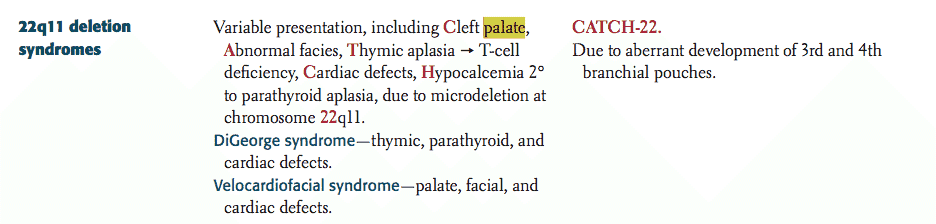

Mastering material takes more time than memorizing. However, the payoff of mastery is meaning:
- Y'all learn in a way that is Boards-relevant
- By putting them into Anki, you'll never have to go back and re-learn anything
- You will take better care of patients. (It's hard to remember sometimes that our ultimate goal was to help real people).
(To read more about Anki, click here).
Only once finding the relevant First Aid sections, how exactly practice you develop mastery?
Utilize Other Resources to Develop Mastery
Med schoolhouse bombards you with unrelated facts. However, what y'all practise with those facts is up to you. When you're tempted to memorize, do this instead:
- Ask (and respond) "Why?" Many of us read the aforementioned cloth. Only a handful volition be able to spot the connections. Seeing the connections oft comes down to asking "why?" and "how?" to focus your mind.
- Apply other resources equally a reference to find farther explanations. No one resource has all the answers. First Assistance is more of a high-level overview and lacks many details. For example, allow'due south say First Aid'due south explanation of amyloidosis is lacking. You can try Goljan. If that doesn't piece of work, Robbins can contain splendid descriptions. Notice I say, "reference." Once you've constitute your explanation, get back to doing QBank questions. You could spend all day reading any of these books. Reading Boards review books may help better your knowledge. All the same, it does footling for your power to apply information technology to clinical vignettes.
- Ask a friend. My all-time friend and I had very complementary strengths/weaknesses. (He ultimately matched to the Hopkins neurosurgery plan). I knew his strengths, and vice-versa. So when a question came up (specially annihilation neuro-related), I knew who to call!
4. Make Connections, Then Anki Cards
It'southward easy to read First Aid and assume you should memorize the facts. Burkitt's lymphoma's translocation? OK, I guess I'll make an Anki carte on that fact. Its response to chemotherapy? Yep, some other card!
Making Anki cards to cram facts is a waste matter of fourth dimension. Then how do yous primary the fabric, never forget it, and crush your USMLE?
For each affliction you learn, ask three simple questions:
- What is the pathogenesis?
- What is the presentation?
- How can I connect the two?
For example,
- Don't inquire: "What is the translocation seen in Burkitt'due south lymphoma?"
- Instead, enquire: "What is the translocation seen in Burkitt'due south lymphoma, and how does that explain its presentation and response to chemotherapy?"
(To answer the question, Burkitt'south is an 8,fourteen translocation. This translocation causes overexpression of the myc oncogene considering myc's expression is at present driven past the Ig heavy chain promoter. Like all oncogenes, myc stimulates cell proliferation. Thus, myc overexpression explains why Burkitt's lymphoma is a VERY apace-growing tumor. Withal, its rapid growth is also its Achilles' heel. Traditional chemotherapy targets rapidly-dividing cells, then Burkitt's is very responsive to chemo).
If yous struggle to make these connections yourself, cheque out the Yousmle Step 1 cards. In it, you'll detect pre-made cards targetting students' most pregnant gaps. Y'all tin can chief more in less time and maximize your USMLE score.
Similarly, if you watch lectures but forget them immediately, cheque out the Yousmle Online Course. Non simply will you brand connections, just with the integration/application questions y'all'll never forget some other lecture again. Cheque out the Yousmle Online Grade hither.
Free Master Anki Questions
What has worked for you or not? Share your experiences in the comments!
Photo past Element5 Digital.
gossettnerisfamands.blogspot.com
Source: https://www.yousmle.com/nail-fundamentals-usmle-step-1-nbme-practice-exams/
0 Response to "Read Theough First Aid in 4 Days"
Post a Comment